Got Bfa in Fine Art Textiles at Rhode Island School of Design Portfolio
Last Updated on May 27, 2021
What should be in an art school awarding portfolio? How do you present a portfolio? What gives y'all the best chance of being accepted by the art school of your dreams? This commodity explains how to make an art portfolio for college or university and is packed with tips from leading art and pattern school admissions staff from around the world. It is written for those who are in the process of creating an application portfolio for a foundation course, certificate, associate or undergraduate degree and contains advice for specific art-related areas, such as Architecture, Fine art, Graphic Design, Illustration, Interior Design, Animation, Game Design, Movie and other creative, visual art-based courses. Information technology is presented along with art and design portfolio examples from students who have recently gained acceptance to a range of art schools from around the world, creating a 9,000 word certificate that helps guide you through the awarding process.

What is an fine art schoolhouse application portfolio?
In improver to meeting bookish requirements, Art and Pattern Schools, Universities and Colleges typically crave a practical art portfolio as part of the awarding procedure (this is ofttimes accompanied by a personal argument and/or an art schoolhouse interview – more on this soon). So whatis this?
The University of the Arts London gives the post-obit definition of an awarding portfolio:
A portfolio is a collection of your piece of work, which shows how your skills and ideas have adult over a period of fourth dimension. Information technology demonstrates your creativity, personality, abilities and commitment, and helps us to evaluate your potential.
Just as every art student is different (with individual strengths, experiences, passions and ideas) every art school has different requirements and expectations. While some universities and colleges accept strict criteria when information technology comes to preparing a portfolio, others are open up and flexible. This variation in expectations can leave students uncertain virtually how to proceed. Even when criteria is clear, applicants may feel overwhelmed and wonder what to draw/paint/make/create, which mediums to use and how to best select and nowadays their piece of work.
Producing an art portfolio is non to be taken lightly. Elevation art schools often take very pocket-sized percentages of applicants. Understanding how to produce a smashing portfolio is crucial. Although it is incommunicable to generate a list of criteria that are advisable for all applicants in every circumstance (there is unfortunately no guaranteed magic formula for creating a winning fine art portfolio) this article highlights tips from experienced admissions staff and makes full general recommendations to assist you produce the best university or art college application possible.
A footstep-by-step guide to creating an art portfolio for college or university
one. Research advisedly and tape the fine art portfolio requirements for a number of courses that interest yous
Deciding which fine art or design school is for y'all is a big decision (our upcoming commodity 'how to observe the best art schoolhouse in the world' volition help with this). While yous consider your options, it is advisable to apply to a number of different schools, in case you are not accepted into your first choice. At that place is no shame in applying to higher or university and not getting in (many highly successful individuals are not accepted into their academy of offset choice); simply being left with no place to go because you didn't apply to enough schools is an easily avoidable circumstance!
Create a listing of art or blueprint schools that y'all would be prepared to nourish and discover their admissions criteria (you can search for art schools in California and New Zealand on this website – more areas coming soon). All university and higher art portfolio requirements are different. Record the exact admissions requirements carefully, well in advance, as deadlines can be earlier than yous expect and portfolios take a long time to ready. Print these out, highlight key data and keep on-hand, so that you can refer to them as needed throughout the application process.
In particular, go on conscientious records of:
- Open up Day times
- Application and Portfolio due date/due south. If yous are currently studying Art at high school, check how the portfolio due dates compare to your own coursework deadlines and exam timetable. In some cases at that place may be issues with work needing to be in two places at one (i.e. submitted for cess at high schoolhouse and delivered to an art school in hardcopy at the aforementioned time). This occurs particularly for students studying international qualifications or applying to art schools in unlike countries, so you lot need to prepare for this in advance. Mark the deadlines of the schools that you lot are applying to clearly on your agenda.
- Size and format of piece of work required
- Whether only finished pieces are expected, or whether sketchbooks, development and process work are also welcome (some schools crave only finished pieces, particularly in the US; others dearest to see development work too).
- Whether submissions are digital, hardcopy reproductions or original artwork. If copies of piece of work must be sent in, find out whether these should be colour photocopies, slides or photographs etc. Detect out whether there are specific criteria for time based media (animation/moving prototype/video/interactive website design and and so on).
- Labelling and presentation requirements. Many art schools have precise portfolio presentation requirements, with work labelled or identified in sure formats, with details virtually titles, dates and materials used, for example. Digital portfolio submission may employ online tools such as SlideRoom.
- Whether in that location are special requirements for international or out-of-land applicants. If y'all are applying from another location, in that location may be special application criteria for y'all. For example, some colleges may accept international portfolios via email, instead of delivered in person.
- Whether supplementary material is needed, for example, a personal argument or written essay (more than on this soon). Art schools typically accept academic requirements set by the university or college as a whole, which may require a divide application grade and a unlike deadline. Y'all may likewise be asked to submit images of work or objects that have influenced your work or teacher recommendations, testimonials or reports (only include these if specifically requested).
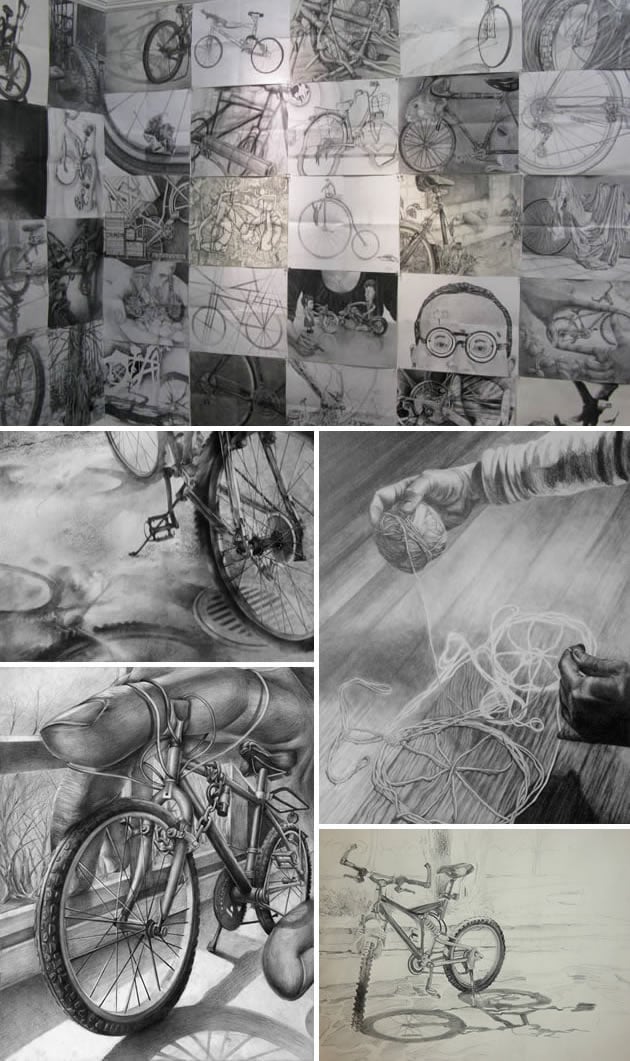
- Requirements nigh what to draw / include. Many art and design schools exit applicants free to select what to include within their portfolio. Unless specifically stated, the portfolio should contain primarily visual artwork, non art history assignments, creative person analysis or extensive note. You may have to submit a combination of personal artwork, piece of work produced in loftier school classes and/or 'abode tests', exams or assignments set past the fine art school you are applying to. In the RISD application portfolio, for case, applicants must answer to three set assignments, such as 'observe and draw a bicycle, or an interior infinite'. Some stunning RISD wheel drawings completed as part of this application portfolio process are shown below:
Enlarged images are by Triye (middle left), Anetta Urmey (centre correct), Boyung yeon Kim (bottom left) and Seraph (lesser right). Height photograph by Mikey Todd:
As some other instance, Parsons the New School for Design asks applicants to submit a portfolio also as the 'Parsons Challenge'. In the by, this claiming has included instructions such as:
Using whatsoever medium or media, explore something usually overlooked within your daily environment. Choose 1 object, location, or activity. Translate your discovery in three original pieces. Back up each piece of art with an essay of approximately 250 words.
Once you accept collected the requirements for the detail degrees you lot are interested in, the next step is to seek out existing portfolio examples.
ii. Look at recent educatee art portfolio examples to gain a visual understanding of what is expected
Seeing examples of existent portfolios is one of the best ways to empathise the standard you are aiming for (and to gain your own art portfolio ideas). Many university and college fine art portfolio examples can be found online or in campus libraries (some art schools retain hardcopy examples to aid students the following year – these can exist invaluable) and a large number of varied student art portfolio examples are featured in this article below. These illustrate the range of different portfolio styles that are possible and aid to show how submissions for detail specialisations or degrees might differ from one another.
If you feel daunted looking at other portfolios, information technology is worth stressing that is usually the best candidates who display their work (this is indeed the case within this article). Exercise not despair if your technical skill is non as strong equally the work you see: call up art portfolios are assessed upon a wide range of criteria (more on this below). If you have a great academic groundwork, innovative ideas and a passion for the subject, you tin can trump someone with technical skill who is lacking in creativity and personal drive. You lot might be surprised to realise how many famous artists do not take flawless observational cartoon skill. Showcase your strengths and back yourself.
A portfolio for art school by Grace Camille Lee:

Grayness's School of Art publish a document containing examples of sketchbook pages from pupil portfolios (some of which are shown below):

A Kingston University awarding by William Govoni:

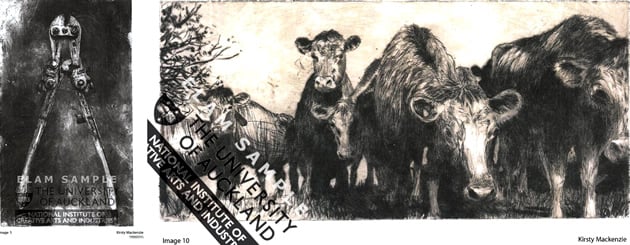
A university application portfolio past Kirsty Mackenzie:
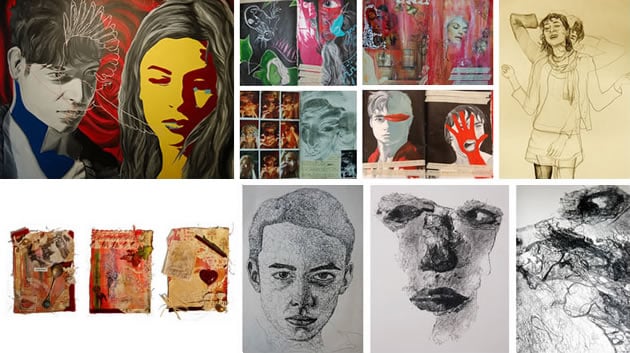
A Kingston Academy application by Lily Grant:
3. Attend Open Days
Open up days are the ideal time to observe out whether an art school is the correct identify for yous (read more about this in how to find the best art school in the earth – coming soon). Open days are as well a bully opportunity to discover out more about the admissions procedure and what is expected past a school in terms of application portfolios. (Every bit mentioned in a higher place, some fine art schools have past portfolios on brandish at the school permanently – in the campus library, for example).
4. Plan your art portfolio, aiming to demonstrate a range of artistic skill and experiences, creative ideas/originality and passion/delivery
This is the most important section of this article, considering it is the area where people are about confused. All over the internet applicants beg to know: 'what should I include in a higher art portfolio?' The answer is this: include a range of recent visual piece of work (completed inside the final year or ii) that all-time communicates your artistic skills and experiences, creative ideas/originality and passion/commitment.
The detailed recommendations below explain this further:
a) Emphasise observational drawing
Most art and blueprint courses require applicants to have a certain level of observational drawing skill. This is essential non but for Fine art specialities, but for many others, such as Compages and Fashion Design. Even degrees that do not seem to obviously focus upon drawing unremarkably welcome the inclusion of this inside an awarding portfolio. For case, Ringling Higher of Fine art and Design states:
For majors without as much cartoon involved, the submission of drawing in your portfolio is always welcome but not required.
An observational drawing is a realistic representation of an object or scene that has been viewed directly in real life (as opposed to something that has been imagined or drawn from a photograph) – read more well-nigh how to produce cracking observational drawings. It tin be produced using any medium or combination of mediums such as graphite pencil, charcoal, pen, ink and/or paint. For the majority of applicants, information technology is highly advantageous to demonstrate the ability to observe something in existent life and draw it accurately. Information technology is recommended that observational drawing (or painting) from first-manus sources form a substantial function of your portfolio.
The aim is that yous:
- Prove to admissions staff that you are able to competently tape shape, proportion, tone, perspective, surface qualities, detail, space and form
- Draw in a personal, sensitive fashion, rather than in a mechanical style (i.due east. not a laborious copy of a photo – drawings from photographs are specifically discouraged). This might involve more creative, expressive, gestural marking-making or the addition of non-realistic elements, textures, materials. In other words, communicate a strong sense of realism, but in a way that besides capture an essence of the subject, rather than an exact, rigid re-create of a scene. It tin can aid to recall almost ideas and meanings behind a drawing – selecting a subject that holds meaning or relevance for you, rather than just selecting any random object to describe.
Clara Lieu, Visual Artist and Adjunct Professor at the Rhode Island School of Design, explains the importance of including original observational drawings in a university or college portfolio like this:
Create original piece of work from direct ascertainment. This is hands down the number one, admittedly essential thing to practice that many students fail to do. Simply doing this one directive volition put you lite years alee of other students.
Achieved drawings are above all else, the center of a successful portfolio when applying at the undergraduate level. You might be a wizard in digital media, but none of that volition matter if you lot have poor drawings.
Szivesen, a portfolio reviewer, explains:
Nigh schools emphasize cartoon from directly ascertainment as their primary basis for the portfolio, no matter what aspect of art yous want to study. That's considering basic drawing skills are fundamental and because cartoon is a little more likely to be a compatible measure out than other areas of art and pattern.
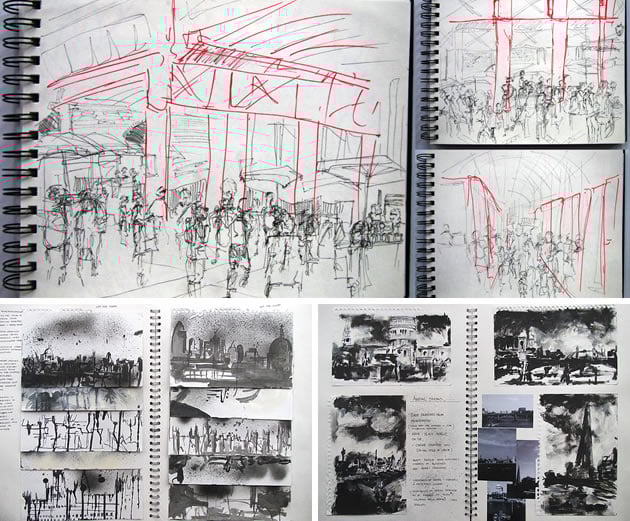
Examples of observational drawings from a academy Foundation course awarding portfolio by Sinead Kirby:
Information technology is worth remembering that yous don't need to attend a formal life cartoon class to consummate observational effigy drawing (although attending such a course can exist an excellent experience for artists and art students and is highly recommended if bachelor). The drawings below past Curelea Loana Andreea (part of a university Foundation course application) show captivating examples of observational figure drawings that could take place in a home or classroom setting:

Observational portraits in a academy Foundation portfolio past Emma Hooper:

b) Explore a range of subject matter – make art about (and of) lots of interesting things
If you are wondering what you should draw: the possibilities are limitless. You may, for example, draw a landscape, however life, portrait, animal, human figure, interior or exterior surround, easily and feet, or any other interesting everyday object – focusing, perhaps, on discipline matter that is relevant for your degree (encounter more near tailoring your application to your particular focus area below) and, more importantly, subject matter that has some meaning and relevance to you. You should try and avoid common or platitude approaches and include a range of dissimilar interesting objects and scenes – and do non exactly replicate the work of another artist.
Dorian Angelo, of Ringling College of Fine art and Blueprint, suggests:
…if you're non sure what to draw, draw the things in your room. Describe your hands, draw your feet, draw your dog. That'south perfectly fine. Try non to get into any clichés or any traps of drawing all the aforementioned thing. We don't want to see a sketchbook full of horses. We don't want to see a sketchbook full of just cartoons or anime. Bear witness that you lot are looking at existent life; that you're looking at different subject affair…
In Ringling College of Art and Design's Game Fine art & Design portfolio requirements, they land:
Please do not copy directly from another artist, or include such things every bit anime, tattoo designs, dragons, unicorns, etc.
In the words of Clara Lieu, Rhode Island Schoolhouse of Design:
Do not copy your work from photographs or other sources. This ways no fan art, no anime, no manga, zilch from some other artist's work. Admissions officers take seen hundreds, probably thousands of images from student portfolios. They are well trained to rapidly spot artworks that have been copied from photographs or that accept been lifted from other resources.
It is never, ever good to have fan art in any portfolio. Past fan art, I hateful drawings of celebrities and other characters that are not your own. That's basically the kiss of expiry, and volition immediately crusade people to run across you as nada more than a hobbyist.
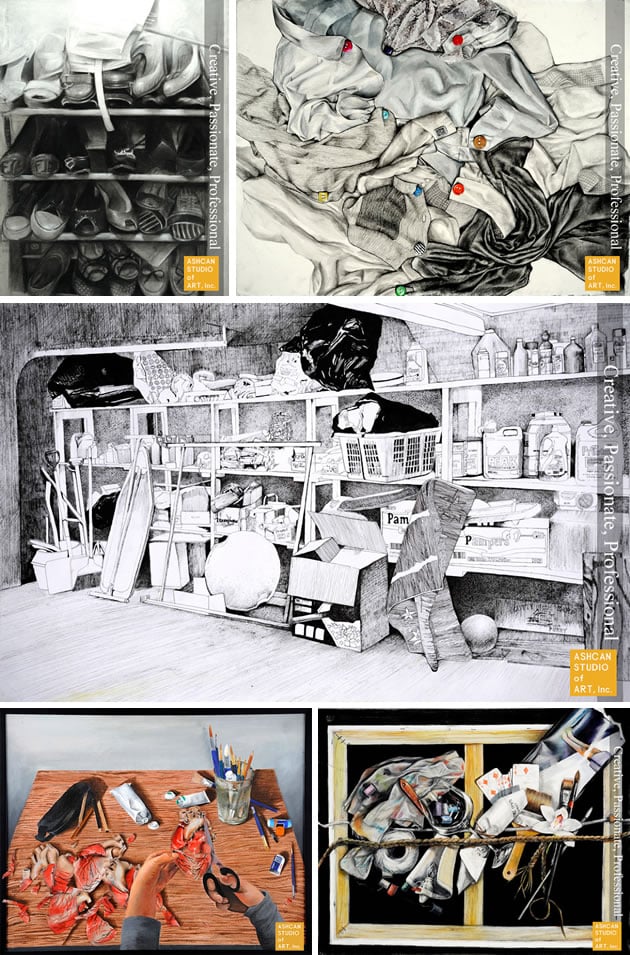
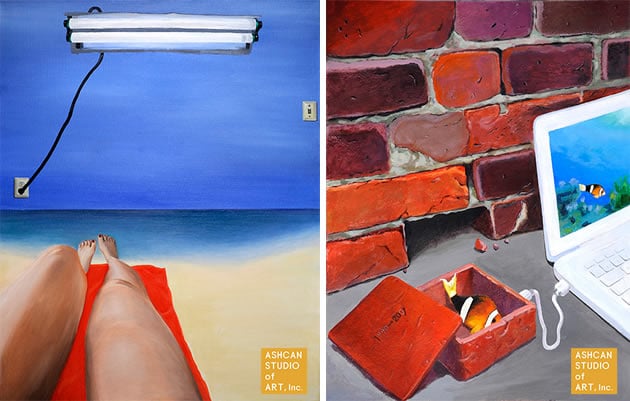
If you are stuck for observational cartoon ideas, these examples by students in portfolio preparation courses at Ashcan Studio of Art may trigger some ideas.
Artwork by Suyeon Moon (shoes, acme left) (accustomed into the Parsons AAS Graphic Design program), Soojin Lee (crumpled clothes, top right), accepted into Parsons Style Blueprint programme with a 4 year scholarship, Insuk Kang (shelving scene, upper centre), accustomed into Parsons Fashion Design with a four yr scholarship, Kalene Lee (bottom left) accustomed into Pratt, Industrial Design, with a 4 twelvemonth scholarship and Jiwon Hwang (lesser right), Parson'due south Manner Design with a four year scholarship:
For more tips virtually what to depict, read how to come up with great ideas for an art project.
c) Employ a range of mediums, styles, art forms and techniques
Your art portfolio should evidence a diverse range of skill and visual experiences. Demonstrate that you lot are able to use and experiment with a range of styles, mediums and techniques and can control, employ and manipulate mediums in a skilful, advisable and intentional mode. Someone who is able to create acrylic paintings, sculptures, prints and pencil drawings, for case, is infinitely more than flexible than someone who is only able to sketch but with a pencil. The quondam applicant demonstrates growth, diversity and a latitude of skill, equally well as an interest in learning new things. The latter may be a 'one trick pony'.
Recommendations:
- Cull a range of mediums that highlight your artistic strengths. Use wet and dry mediums (graphite, charcoal, ink, pastel, acrylic, watercolour, oil, ceramics, film etc and other mixed mediums) and paint / draw upon a range of different surfaces (see here for great ideas about things to describe or paint on if you are looking for new ideas), but don't include weaker work, just for the sake of roofing a greater range of mediums.
- Explore a range of appropriate styles. Choose artistic styles that showcase your skill, interests and strengths. Don't try and judge what the university of fine art school would prefer (despite common misconceptions, they rarely favour 1 manner of fine art-making more than another); choose those that align with your strengths.
- Experiment with a variety of tools, techniques, processes and fine art forms. Unless otherwise specified, an application portfolio may include drawings, paintings, photography, digital media, design, three-dimensional work, spider web pattern, animation, video and well-nigh any other blazon of artwork. This does non mean you should try to include every different technique or fine art grade possible (this would create a scattered and incohesive portfolio) only that you demonstrate that yous are willing to experiment and attempt new fine art-making experiences, focusing on areas that interest you lot and highlight your strengths.
A portfolio past Kisa Sky Shiga, completed as function of a portfolio preparation course at Ashcan Studio of Art:

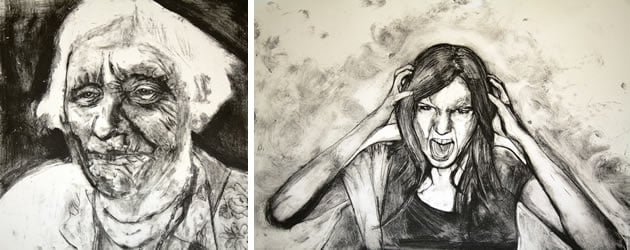
Printmaking in a academy Foundation awarding by Henry Richardson:
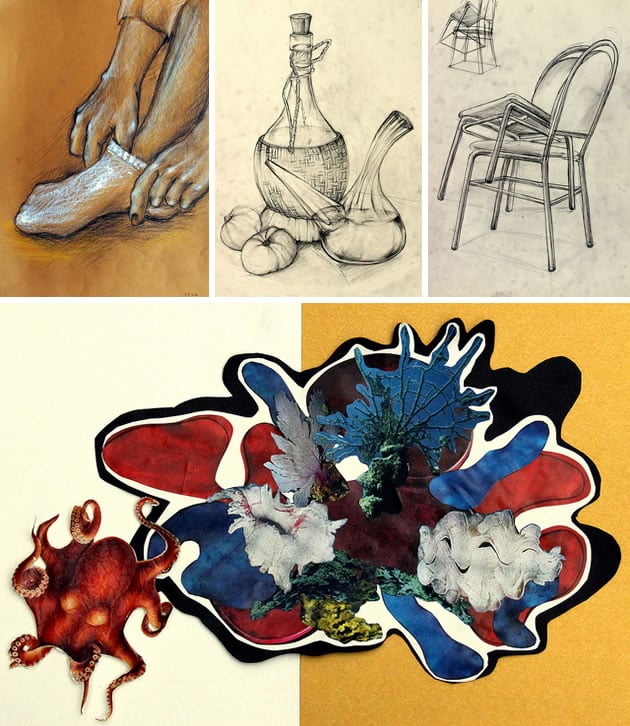
A university Foundation application portfolio by Aqsa Iftikhar:

A university Foundation application portfolio past Ayse Kipri:
e) Include a range of varied, well-counterbalanced compositions – show an 'eye for aesthetics'
All work – even observational drawings – should show that yous understand how to compose an image well, arranging visual elements such as line, shape, tone, texture, colour, grade and colour in an pleasing manner. Compositions should be well-balanced and varied – with a range of viewpoints/scales included throughout the portfolio.
- Avoid cartoon items floating in heart of a folio unless this is an intentional, considered decision (see our Fine art educatee'southward limerick guide (coming before long) which explains more about how the formal visual organisation of artwork. Think about the shadows, spaces and surfaces in and around objects. Recollect carefully nigh cropping of images and positions of items within each work.
- Select and utilize advisable colours, making certain that if multiple works are arranged on one folio, the colours piece of work well together too (more than on this in the portfolio presentation section below)
- Make certain the proportions and spatial relationships between dissimilar elements in graphic designs (such as text, images and space) are carefully considered
f) Include process / development piece of work if permitted
Some fine art schools – particularly in the U.s. – crave that every piece in your application exist a finished, realised work. Others – particularly those in the U.k. and NZ – love to see process, development or sketchbook work. If an art or design school specifically states that this textile is permitted, this is an splendid opportunity to flaunt your skills, delivery and depth of knowledge. The research and processes undertaken to develop your work are often as important as the final work itself and allow the selection panel to empathize your work in context and see how it has been initiated and adult. Procedure and evolution work helps colleges and universities to understand how you think (the ideas and meanings behind pieces, for example) and see that you are able to take an thought from concept and develop information technology through to a concluding resolution. Information technology provides evidence that you lot are able to analyse / experiment / explore and trial different outcomes and make sound critical judgments.
We want to see how you generate and develop ideas from your visual research. It is important that we see how they progress from the starting point right through to the conclusion of your ideas / projection. – Grays School of Art, Scotland.
Images of pages from your workbook/south can be very helpful to the pick panel. This could include: evidence of ideas, thinking processes, experimentation and assay. – Elam School of Fine Arts, University of Auckland, New Zealand
Development work might include sketchbook or workbook pages that testify:
- In depth investigations into subject field matter (sketches / photography and other visual documentation of starting time-paw sources)
- Investigations into mediums, materials and techniques and technologies
- Development of concepts, compositions or details
- Written analysis aslope visual work and notation discussing ideas behind your work
- Show of links to the historical, contemporary and/or social context in which works have been made – i.e. connections to artists and existent earth bug
- Annotated screen captures, contact sheets, and documentation of digital processes
A university Foundation awarding by Lola:
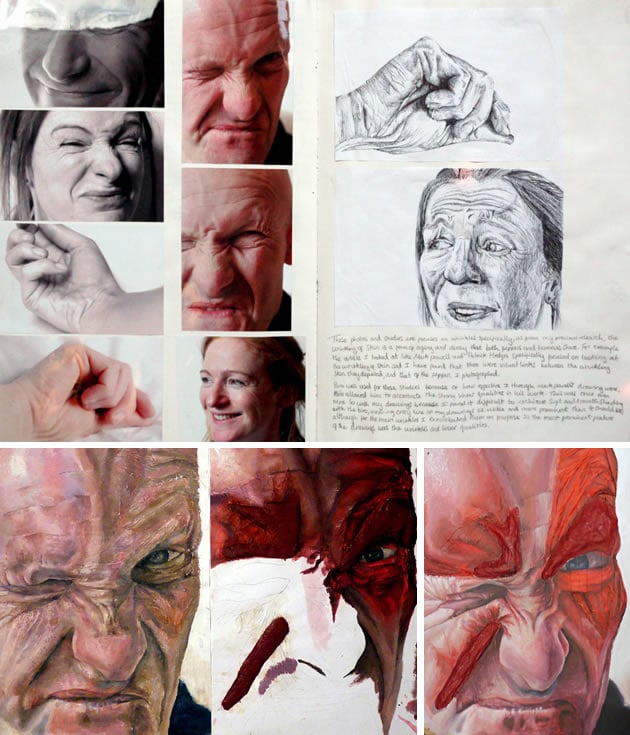
A university Foundation application by A Level Fine art educatee Heather Meredith:
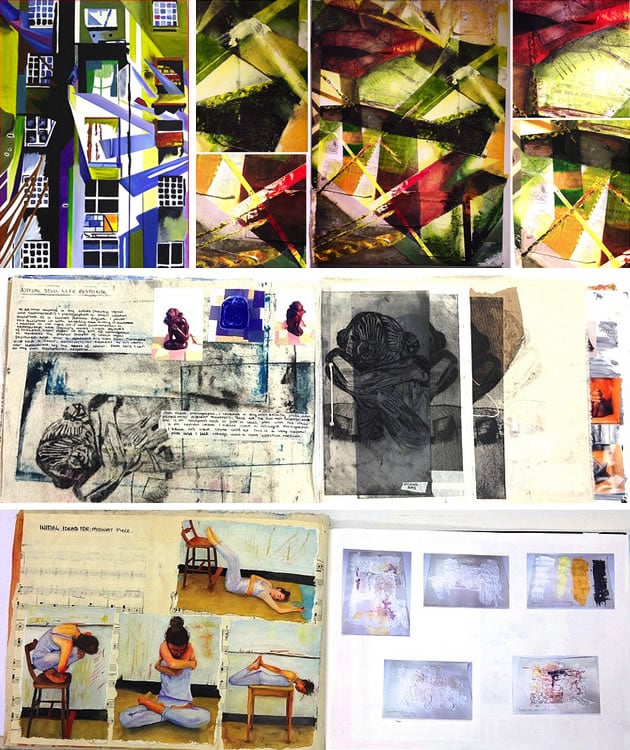
A university Foundation application portfolio by Violet Volchok, who was offered a place on courses at Kingston and Ravensbourne, United Kingdom:

This video contains a good overview of what a portfolio might incorporate, particularly for universities that request procedure / development work:
For more tips about producing great process piece of work, you might find it helpful to read our guide to producing an outstanding high school art sketchbook or how to develop ideas in an art project.
Annotation: If development piece of work is not permitted equally part of the portfolio itself, it is usually appropriate to bring this to the interview.
one thousand) Communicate creative ideas: exist original
It is important to retrieve that artistic skill must be accompanied by creativity, original ideas and some grade of visual curiosity. In other words, technical skill is no utilise if you are unable to think of how to put this to utilise in a unique, interesting manner. Someone who is able to generate original and captivating ideas that rip into your heart and soul is far more highly-seasoned than someone who produces ho-hum, predictable, nonetheless technically excellent artwork. Although skill is an excellent nugget – and a certain level is necessary – applicants to colleges and universities and art schools should not aim to be glorified 'photocopiers', only rather the creators of exciting, unexpected visual outcomes. To achieve this within your portfolio, information technology may help to:
- Be experimental – try different things and push techniques, materials and engineering in innovative and unexpected ways
- Brand art about something (visually communicate ideas) rather than simply laboriously draw a scene – demonstrate your intellectual potential.
- Be yourself – reveal your personality and interests. Never submit art that is an imitation of someone else's. Aim for artwork that is new, fresh and nigh something that matters to you lot. Don't replicate whatever of the portfolios you see on this page or elsewhere. Your portfolio should be individual to you. Permit your portfolio reverberate your strengths, interests and experiences and represent who you lot are.
On the whole, greater emphasis is put on evidence of your visual marvel, thought generation and exploration, and your energy, engagement and contextual awareness, than on high level technical skills and finish. – Edinburgh College of Art, Scotland
…[A good portfolio] demonstrates how y'all can remember in innovative and contrasting ways, and shows originality, inventiveness and commitment to being creative. – Massey Academy, New Zealand
… stand out from the oversupply by pushing the boundaries of a prescribed curriculum, personalising a theme or project to demonstrate their invention and creativity. Work that reflects an bidder'due south ain enthusiasms, thought processes and ideas is ever of interest to the selectors. – University of Dundee, Scotland
It'due south no good promoting firm styles, equally that makes all students' piece of work expect the aforementioned. If a student is showing a piece of work from a form, it's important that it likewise shows a personal theme. – Helen Heery, Academy of Salford, United Kingdom
A portfolio assignment by Amelia Eaton:

A Fine Art portfolio past Karen Park, completed during a course at Ashcan Studio of Fine art:

A university Foundation awarding by Anna Clow:

A Manner Design portfolio by Halim Ki, completed during a course at Ashcan Studio of Art:
Some bully tips are independent in this video by the University of the Arts London about the importance of ideas, enthusiasm and creativity – providing some excellent thoughts, peculiarly for those who might not take gained a strong Fine art education at high schoolhouse:
h) Communicate passion, commitment and enthusiasm
Universities want people who will represent their school well – who volition go on to do great things that will reflect positively upon their identify of written report. They want passionate, great students who will cope with the workload and who intend to really become on and make use of their degree. This means that you must convey a sense of passion, commitment and enthusiasm inside the portfolio (also as during the interview – more than on the art schoolhouse interview shortly). To exercise this, y'all can:
- Ensure that piece of work from classroom projects is thorough, personalised, cocky-motivated (goes the 'actress mile').
- Include some personal, independent, self-directed piece of work that has been completed outside of the classroom. This helps to give an indication of your current involvement and involvement in the arts.
During the process of reviewing portfolios, the Ruskin staff ever wait for work that goes beyond the mere fulfilment of School curricula. Nosotros search for highly motivated activeness, over and above any projection-based work, and for a breadth of engagement, a sense of purpose and a strength of opinion in the mode the portfolio is edited. Important for u.s. is to exist able to discovering a sense of the temperament laying behind the work, and sense the deeper interests that inform the portfolio. We are not interested in finding a item formula or a specific way, only in signs of energy, ambition, critical reflection and creativity. – Ruskin School of Art, United Kingdom
Personal art is the work done outside of a classroom situation and reflects the artists' unique interests in use of materials, subject area matter and concept. Work tin can be completed in whatever media including (just not limited to) cartoon, painting, photography, mixed media, digital/reckoner fine art, picture/video, ceramics, sculpture, animation and functioning art. – Kavin Buck, Schoolhouse of Arts and Architecture at the University of California Los Angeles, United States
Involvement in art must exist more than casual. – Tom Lightfoot, Rochester Institute of Technology, United States
Emma Rose, who works in the faculty of arts and sciences at Lancaster University, advises that students include some self-generated work – not just the projects that have been assigned on courses. "Nosotros want someone with that actress spark – perhaps you've gone off with a camera to take interesting photos." – The Contained
Self-initiated projects (artwork created independent of classroom assignments/exercises) are particularly encouraged. – UCLA Department of Art, United States
Ultimately, it's all about passion and ideas, then if y'all include the kinds of things that you lot're nearly excited well-nigh, that y'all're virtually proud of, then chances are your portfolio submission will make a strong impression. – Ringling College of Fine art and Design, United States
i) Tailor your application to suit your degree
Portfolio guidelines for different areas of Art and Design are often similar, but it tin be wise to modify your portfolio then that information technology is appropriate for the degree you lot are applying for. Rather than creating a completely different set up of images for each specialisation or major, nevertheless, a submission can be tweaked slightly, and so that information technology showcases relevant strengths and an involvement in the expanse yous are applying for (for example, submitting observational drawings of metropolis scenes or building interiors for an architecture application etc (although this is non necessary – more on architecture portfolios below).
Every bit an instance, digital based degrees may like to encounter evidence of technological awareness and capability and the ability to work with a range of digital platforms, aslope traditional non-digital techniques. This might include time-based interactive piece of work (film, animation, video, website design).
The following list gives some guidance about the sort of material that mayexist helpful for specific areas, in addition to the items discussed to a higher place, such as observational drawing. As with all recommendations in this commodity, you should refer to the academy or college you are applying to for precise requirements.
Graphic Design Portfolios:
- Graphic pattern print piece of work or web graphics
- Font pattern or use of typography
- Graphic illustrations
- Video graphics
- Interactive web media and whatsoever other related projects
A university Foundation application portfolio past Jacob Wise:

Architecture Portfolios:
- Many students assume that an architecture application portfolio must be filled with drawings of buildings or architectural designs. This is about ever notthe case (every bit with all other recommendations made in this commodity, you should check the requirements of the particular class yous are applying for). Admissions staff typically wish to run across evidence of inventiveness with a range of media and strong observational drawing skill (as described in the starting time part of this article), including the power to represent infinite, perspective and 3D course. This can be achieved through exploration of completely unrelated field of study matter, such equally nonetheless life, landscapes and human class. If you lot take a choice, however, drawing buildings, manmade structures, interior/exterior spaces, furniture and/or mechanical parts and and then on, may help to demonstrate an interest in architectural design.
- Compages schools unremarkably exercise Non require formal technical drawings (instrumental or computer generated plans / orthographic projections etc) and if these are accepted equally part of the application portfolio, they are oft limited in quantity, and then that you lot include a sufficient range of paw-generated piece of work. You are notexpected to sympathise how to blueprint a building – this is what you learn upon the course.
- 3-dimensional sculptures, installations, casts and/or model constructions tin can be great to include, as these communicate spatial awareness and an interest in working with 3D course. These might include conceptual models made from cardboard, paper, wire, wood and other found materials, for instance.
- Artwork in a wide range of mediums (printmaking / photography etc) are typically accepted.
- Annotation: Some universities and architecture schools specifically request that the portfolio is notfilled with Blueprint Engineering piece of work, preferring to see piece of work that has been produced as part of loftier school Art courses. (Although some high school Design Technology courses provide first-class preparation for architectural degrees, Fine art courses typically offering a stronger grounding in observational drawing and limerick).
Examples of observational drawings submitted as part of an awarding to the University of Auckland, Schoolhouse of Architecture, New Zealand:
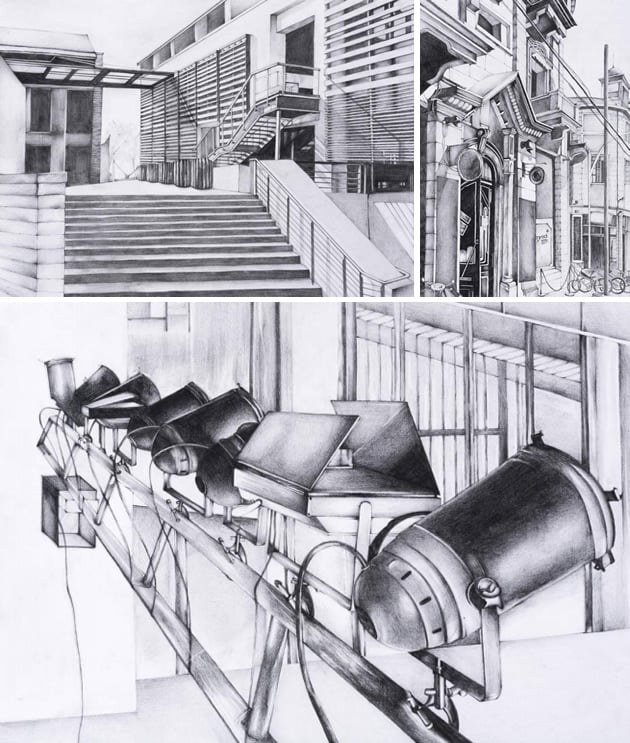
Images from an architecture application portfolio by Irence One thousand, completed while studying at Ashcan Studio of Art:

An architecture portfolio example by Ken Liang, completed under the guidance of Evangelos Limpantoudis from the Architecture School Review who helps students gain admission to elevation architecture schools from around the earth:

Fashion Pattern Portfolios
- Figure drawings – for example drawings of clothing on models
- Documentation of original sewing, textiles or way design projects
Office of a Kingston Academy Art Foundation application portfolio past Annabelle Holden:
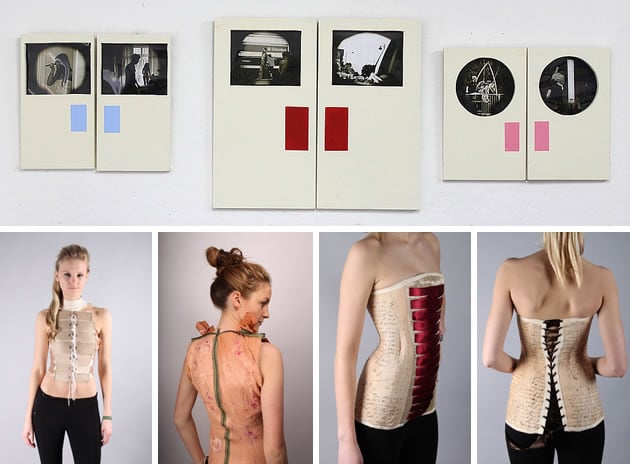
A Manner Design portfolio by Jinsoo Choi, prepared during a course at Ashcan Studio of Fine art:

Game Art Portfolios:
- Storyboards
- Original grapheme designs
Production Design Portfolios:
- Subjects like product design often require strong practical, analytical and communication skills, as well every bit the technical and conceptual ideas and cocky-motivation required by other art-related degrees. This means that evidence of working with materials and in both 2d and 3D can be beneficial.
Film School Portfolios:
Filmmaking may combine many different skills including performing arts, music, literature and writing. As a outcome, portfolio requirements may be quite different from a traditional art school application. Applications may include:
- Screen shots from original films, animations, videos or digital applications with video excerpts embedded (make sure these are short as admissions staff will not have fourth dimension to view long reels of footage, and/or captured every bit a storyboard with screenshots). These may be submitted on DVD or flash drives or as URL links to YouTube, Vimeo or embedded on a personal website or blog (see why Art students should have their ain website and how to make one)
- Mode, costume or set pattern
- Storyboards
- Website design and multimedia piece of work
- Evidence of involvement in theatre or performing arts
- Screenplays and creative writing may also be appropriate
five. Take time to create new artwork and/or improve existing pieces (if required)
Once you have planned what y'all will include in your portfolio, you should fix aside a period of time to produce this. If y'all have not taken loftier schoolhouse Fine art classes, preparing a page will take a lot of work – almost vi months to consummate a portfolio from scratch (retrieve it is ideal to create more work than is needed, so that y'all can carefully edit and remove the weaker pieces). See if your high schoolhouse Art instructor can help (even if y'all don't take Art). An experienced teacher will often have a long history of helping / observing students apply and may have a good knowledge of what helped successful candidates in the past. If your own art teacher is not experienced with helping students employ to university – or you experience yous need more aid preparing your portfolio – find out if there are local courses or workshops that address how to make a portfolio for art school. Portfolio preparation classes are often run past the universities / colleges themselves. These may be relatively inexpensive weekend workshops or be yearlong, such as Foundation or Art portfolio courses. Making a portfolio can feel less daunting when yous produce work with a form of others and seeing others produce piece of work can be motivating and inspirational.
Y'all volition likely accept to utilise a considerable portion of your holiday and holiday time to create work or meliorate existing pieces – as well as generate personal piece of work outside of your curriculum or complete 'dwelling tests' or assignments if required.
The about of import detail of preparing your portfolio for college admissions is to remember to give yourself plenty of fourth dimension and have fun with it. It is almost incommunicable to create quality work if you lot are nervous and nether a time constraint. Don't wait until the last minute, and make enough work so you tin can edit together the best portfolio for each school yous plan to apply to. – Kavin Cadet, School of Arts and Architecture at the University of California Los Angeles, United states of america
When it says put together a portfolio of 12 pieces, it doesn't necessarily mean merely make 12 pieces. It'south easier to merely make, make and make and and so narrow it downward to 12 pieces. Not simply will you have more than to cull from, an admissions counselor during a portfolio review can help you decide what to submit for a final awarding. So don't limit yourself, just create! Katie, Admissions Counsellor, Parsons, United States
A University Foundation application portfolio by Nina Cavaviuti:

6. Select and Review Piece of work
One time you accept completed a significant body of work, seek feedback and change / improve / redo pieces. Don't exit this until the last minute, because yous will run out of time if changes are needed. Build in reflective time – fourth dimension to set information technology aside and come back to information technology with fresh eyes.
This fantabulous video by Paul Stanford, Head of Department of the Foundation Course in Art and Design at Kingston Academy, shows the evaluation of an average student portfolio to be offered a identify. It highlights the importance of editing a portfolio carefully and eliminating weaker work, besides as ending a portfolio well, so that the final impression is a expert i.
Towards the eye of the portfolio, Paul begins to notice technical deficiencies – 'a scrap of a ho-hum cartoon, y'all might say' – 'information technology'southward not a keen life drawing, is it?' – a reminder that students should only submit work that plays to their strengths. The student's skill set every bit a whole and estimated potential is evaluated, with observational drawing skill only one part of this equation.
Almost people get likewise shut to their own work and cannot run across it considerately. Bring an unbiased person (non friends or family) to help with your final portfolio pick, ideally someone who has a background in art or design. When selecting work, aim for quality over quantity, avoid repetition and include variety of subject thing, skill and medium.
Read the school's suggestions for portfolio submission carefully. Near will say "10 to 20 pieces" and I can tell yous that more is oft not better. If you take ten really stiff works to submit, and so the quality level noticeably drops, improve to show 10 uniformly adept works than a whole range. – Anonymous answer on Yahoo
Be selective. …don't submit work that yous are not proud of just for the sake of having diverseness. – Virginia Commonwealth University
Select projects that show a range of media and subject thing, while yet emphasizing your strongest work. – Carnegie Mellon University
It's expert to start with lots of piece of work and then exist super selective with what you put in the portfolio… – Charlotte Cook
Some institutions offer the opportunity to have your portfolio reviewed before submission (a 'preliminary portfolio review'). Usa students are also able to attend National Portfolio Day, where they are able to receive feedback on their portfolio-in-progress from university and college representatives. These are held all over the United states and are highly recommended. Lines are long and you lot should make it early on to ensure that yous are able to speak to the schools of your first choice.
At this result, brace yourself for harsh words. It's not uncommon for students to be told at National Portfolio Day that they essentially have to showtime over from scratch because their portfolio is headed in the incorrect direction. Reviewers will be aboveboard and direct nearly the quality and blazon of work that their schoolhouse is looking for, so don't be discouraged if y'all go a tough critique. Rather, be glad that you lot got the feedback you lot needed to get yourself headed in the correct management. – Clara Lieu, Rhode Island School of Design, The states
Accept constructive criticism and advice – don't exist offended (you'll demand to get used to this if you desire to become to fine art school!) – Virginia Republic University, United States
What Should be In a Portfolio? This video from the University of Arts London explains how a skilful portfolio should have a sense of journey or 'story unfolding'. It is a expert video that helps you understand which pieces to select. Information technology is a good reminder to show a range of creative skills and techniques and well as communicating your personality, interests and a sense of your ain experiences.
7. Organise, photograph and present your fine art portfolio
Presentation of your portfolio is very important. The organization and arrangement of your portfolio has a straight impact upon the way the work is perceived. A adept layout helps to communicate an eye for composition, a professional approach, shows your commitment and desire to nourish a university or higher: it leaves a positive, memorable impression. Poorly cared for work that is thrown together in a sloppy, thoughtless layout, or is overly decorative and laboured in presentation, significantly detracts from the quality of the artwork. Admissions staff may spend less than 5 minutes looking at your portfolio, and then beginning impressions count.
This video about preparing a portfolio by Academy of the Arts London contains some great reminders about presenting a portfolio. In particular, they suggest that you should 'put cypher in your portfolio that you tin't talk nigh' and organise it so that it is piece of cake to navigate. It too explains that while a portfolio should non be crammed full of everything a pupil has produced, it should not be over-edited: 'pared down and so much that we can't actually see little glimpse of potential'.
Carefully photo work for digital submissions and any work that is 3-dimensional/sculptural or that exceeds size specifications for hardcopy submissions (meet our guide to photographing fine art like a pro – coming soon). Reread portfolio presentation requirements carefully to brand sure that you present exactly what is required by the admissions departments of each of the schools that you are applying to (specially size and weight restrictions).
Here are some general portfolio presentation tips:
a) Select a uncomplicated, professional format that allows your work to exist viewed easily.
If a portfolio size isn't specified, choose something that works well for your own work and that tin can exist transported easily. A3, A2 or A1 is unremarkably fine.
From my own experience, I find A3 is the nigh ideal (both in didactics and beyond). A3 marks the perfect balance because you can sufficiently display your artwork finer, while making it easier to transport. – Recent United kingdom of great britain and northern ireland art school bidder from the StudentRoom.
Choose a flat type of fine art portfolio case or folder that opens and close easily, while protecting work so that it doesn't get creased. (Avoid rolling work up, every bit it will be hard to go it to prevarication flat). The portfolio case may be a spine-mounted leather fine art portfolio (normally found in all skilful fine art retailers – run across examples on Amazon) or a clear non-reflective clear file folder, for example. It doesn't need to exist overly expensive: avoid extravagant folders and choose one that is simple, clean and applied.
Although presentation is important for your portfolio, don't spend loads of fourth dimension and coin buying flashy folders advises Wendy Rochefort, who is studying a foundation degree in Fine Art at Cornwall College. "Elementary mounts and a tidy end are fine." – The Independent
Have all sheets securely bound in such a way as to permit all sheets to lie flat when the portfolio is open. Be able to be hands and safely handled. There should exist no exposed metallic binders, staples or similar fittings. Canvas metallic or other heavy or abrupt materials should not exist used for portfolio covers. – Schoolhouse of Architecture, University of Auckland, New Zealand
Choose apparently, neutral portfolio colours (black, grey, white etc) and avoid busy, decorative or patterned presentations (you want emphasis to remain on your artwork). Similarly, avoid reflective surfaces that hamper vision (for instance, glazing paintings or clearfiles with shiny plastic).
Go on the presentation format uncluttered and relevant. Avoid over decorating your portfolio as this tin detract from the content. – Academy of the Arts London, United Kingdom
b) Order the work in a logical and aesthetically pleasing way.
Outset and end with a not bad piece of work, and then that you create a cracking initial and final impression. Space other great work evenly throughout your portfolio (avoiding a clump of weaker piece of work). Recall about grouping similar piece of work together, by medium, field of study or style – perhaps every bit a serial of projects – or chronologically. An assessor must be able to 'empathize' your portfolio and see any connections between pieces (for example, show the artistic journeying betwixt development piece of work/sketchbook pages and final outcomes). Aim to make it appear coherent, rather than a whole lot of scattered, disconnected pieces.
Narrative is an important element to consider when preparing a portfolio. How work is laid out and displayed changes how information technology is read, significant the placement of pieces is vital to showing tutors your all-time ability in the shortest amount of time. – The Guardian.
Call up about the limerick of each page – which images are facing each other, whether the colours work well together etc. Consider the relationships between pieces, especially the human relationship between sizes, colours and format of work.
Add greater contrast, crop tighter to make more dramatic compositions. Add a little more than intense color. Y'all'd be surprised how much stronger your work can look with just a few careful additions. – Karen Kesteloot, a portfolio evolution coach from PortPrep
c) Avert unnecessary repetition
If you lot are asked to submit a specific number of images, ensure that each of these is a dissimilar piece of work. Where a certain number of sheets are asked for, it may be possible to mountain smaller works onto a single sheet. If you lot want to submit different angles of one piece of piece of work, it is commonly best to digitally submit these on ane sheet, or as ane image. Read the guidelines of the particular university or college y'all wish to utilise to advisedly to find out what is expected.
There is no virtue in quantity lone and candidates should non include multiple colour variations of prints, for example. Duncan of Jordanstone College of Art and Design, Britain
Do not include detail photos of piece of work in your portfolio unless you consider them absolutely necessary. Nether no circumstance should more than two detail shots be included. – Yale School of Art
d) Trim / ingather everything in a make clean surround and attach to the portfolio (if submitting in hardcopy)
- Brand sure work is thoroughly dry out and that pages will non stick together
- Make certain work is secured well, with no loose work falling out when pages are opened
- Use fixative to stop charcoal, chalk or graphite drawings smudging and ensure that these are not directly facing other artworks in the portfolio. Existing smudges can be erased from drawings using a putty safe, prior to spraying with fixative.
- Avoid fold out flaps, and other irritating formats that may distract or irritate the viewer
- Make certain photographs are focused, free of fingerprints, printed on matt (not-cogitating) paper and are large plenty to come across details clearly
- Don't mountain things with distracting borders (it is not usually necessary to mount or mat your piece of work); faming piece of work is unnecessary. Let the work stand on its own. A clean, professional and minimal style is usually ideal, every bit described in a higher place.
e) Presentation of digital work (if submitting online or upon DVD or memory stick)
- If y'all wish to include digital material with a hardcopy submission, ensure that the fine art school you are applying to is able to view piece of work digital fabric in particular format (video / CD etc). Check carefully what blazon of new media presentations they accept and accompany this with a printed hardcopy version (screenshots etc) and a note about the programmes used, in case difficulties arise.
- Characterization all digital files sensibly, such as firstname-lastname-awarding.pdf rather than 4690243fxz.pdf
- Ensure images reflect the true color and appearance of the artwork and are cropped correctly, without unrelated, disctracting groundwork items
- Ensure moving paradigm or video footage is cropped to a sensible length (admissions staff usually have tight time limitations)
- Consider embedding videos upon your own website, rather than as a link to youtube / vimeo. This creates a much more professional properties to your application (see how to create your ain website).
- As with physical submissions, recollect carefully about the system and grouping of images.
- Salve a record of all digital submissions as a backup!
f) Label work clearly just unobtrusively
- Use minor, clear writing to label work in a way that doesn't detract from the artwork. If labelling guidelines are non given (sometimes a separate canvass containing details of each epitome is required), characterization work in the corner or on the reverse with the championship, mediums, dimensions, dates and additional info as required. Avoid decorative font and excessively large headings.
- Proof for spelling errors and inaccuracies (become someone else to check this besides). Brand certain all links to digital moving images work.
Desire more aid with applying to Art school?
This article is accompanied past our Guide to the Fine art school interview (coming soon) – packed with advice from those who have recently applied. To make sure that you don't miss out on this article, please make sure that you are subscribed to our newsletter using the sign upward form below!

Amiria has been an Art & Design teacher and a Curriculum Co-ordinator for 7 years, responsible for the course design and cess of student work in two high-achieving Auckland schools. She has a Bachelor of Architectural Studies, Bachelor of Architecture (First Class Honours) and a Graduate Diploma of Instruction. Amiria is a CIE Accredited Fine art & Blueprint Coursework Assessor.
Source: https://www.studentartguide.com/articles/how-to-make-an-art-portfolio-for-college-or-university
0 Response to "Got Bfa in Fine Art Textiles at Rhode Island School of Design Portfolio"
Publicar un comentario