Find the Center and Radius Then Write the Standard Equation of Each Circle Brainly
Equation of circle passing through 3 given points
Find the equation of the circle passing through the points P(2,1), Q(0,5), R(-1,2) | ||
Method 1 | Substitute points in the general form of circle and solve coefficients | |
| Let the circle be (2,1) : (0,5) : (-1,2) : | Start with the General Form of circle. Substitution of P, Q, R. | |
| 2D + E + F = -5 �K.. (1) 5E + F = -25 �K�K�K(2) D �V 2E �V F = 5 �K�K.(3) | Simplification | |
| (1) + (3), 3D �V E = 0 �K�K. (4) (2) + (3), D + 3E = -20 �K.. (5) From (4), E = 3D �K�K�K�K(6) Subst. (6) in (5), D + 9D = -20 \ D = -2 �K�K�K�K�K�K. (7) Subst. (7) in (6), E = -6 �K�K.. (8) Subst. (7), (8) in (1), F = -5 | Solve the equations. Eliminating F and get a simultaneous equation in D and E. Solve D and E and finally get F. | |
| The equation of the circle is | Substitute D, E, F in the General Form. | |





Find the equation of the circle passing through the points P(2,1), Q(0,5), R(-1,2) | ||
Method 2 | Use Centre and Radius Form of the circle. | |
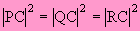
| Let the center and radius of the circle be C(a,b) and r. |PC| = |QC| = |RC| | The distance from center to the given 3 points are equal. | |
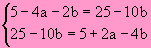
| 5 - 4a - 2b = 25 - 10b = 5 + 2a - 4b | Simplification. Note that there are no ��square�� terms. Get a simultaneous equation in a and b. | |
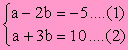
| (2) �V (1), 5b = 15 \ b = 3 �K.. (3) Subst. (3) in (1), a = 1 \ C = (3, 1) | Solve a and b. The center of the circle can be found. | |
| r = |PC| | Solve for the radius. | |
| The equation of the circle is | Use the Center- radius form to get the equation of circle. | |



Find the equation of the circle passing through the points P(2,1), Q(0,5), R(-1,2) | ||
Method 3 | The perpendicular bisectors of two chords meet at the centre. | |
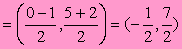
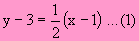
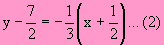
| Let L1 and L2 be the perpendicular bisectors of PQ and QR respectively. Mid-point of PQ Mid-point of QR Gradient of PQ Gradient of QR Since L1 ^ PQ, L2 ^ QR, Gradient of L1 Gradient of L2 = L1 : L2 : | Find the mid-points of two chords. Find the gradient of two chords. Product of gradients of perpendicular lines = -1 Find the equations of perpendicular bisectors using gradient-point form. | |
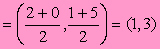
| (1) �V (2), \ x = 1 �K. (3) Subst. (3) in (1), \ y = 3 \ C = (1,3) | Solve for the center. | |
| r = |PC| | Solve for the radius. | |
| The equation of the circle is | Use the Center- radius Form to get the equation of circle. | |





We use another set of three points to work for the other methods below.
Find the equation of the circle passing through the points P(-6,5), Q(-3,-4), R(2,1) | ||
Method 4 | Converse of Angle in semi-circle. | |
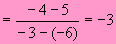
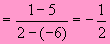
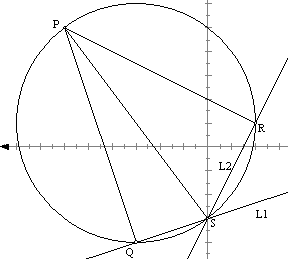
| Gradient of PQ Gradient of PR Let L1 ^ PQ and L2 ^ PR. Let L1 and L2 meet at S. Gradient of L1 = Gradient of L2 = 2 | Product of gradients of perpendicular lines = -1 | |
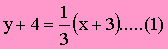
| Equation of L1: Equation of L2: (1) �V (2), \ x = 0 �K.. (3) Subst. (3) in (1), y = -3. \ S = (0, -3) | Use Point-gradient form to find equations of L1 and L2. Solve the equations, the point S can be found. | |
| P = (-6, 5) S = (0, -3) PS is the diameter of the circle. The equation of the circle: (x + 6)(x - 0) + (y �V 5)(y + 3) = 0 | Apply the theorem of Converse of Angle in Semi-circle we can see that P, Q, R, S are concyclic with PS as diameter. Use diameter form to find equation of circle. | |



Find the equation of the circle passing through the points P(-6,5), Q(-3,-4), R(2,1) | ||
Method 5 | System of circles. | |
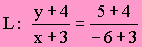
| Equation of PQ : L : 3x + y + 13 = 0 Circle with PQ as diameter: C : (x +6)(x+3) + (y �V5)(y + 4) = 0 | Two points form. Write PQ in general form. Use the diameter form to find the circle with PQ as diameter. | |
| The system of circle passing through the intersections of the circle C and the line L can be given by | This system of circles must pass through points P and Q. | |
| We like to find one of the circles in this system which passes through the point R (2,1). Subst. R(2,1) in C + kL we have, \ k = -1 The required circle is : | Find k. The system of circles passes through P, Q. The circle also passes through R. | |





Find the equation of the circle passing through the points P(-6,5), Q(-3,-4), R(2,1) | ||
Method 6 | Angles in same segment . | |
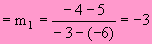
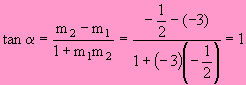
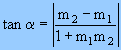
| Gradient of PQ Gradient of PR Let a be the angle QPR. | You may investigate the case for which the absolute value is added: | |
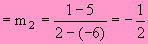
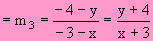
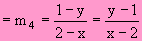
| Let S(x, y) be any point on the circle. Gradient of SQ Gradient of SR Let b be the angle QSR. | We do not include the absolute value in the formula. The order of m is therefore important. | |
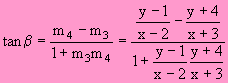
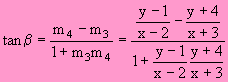
| Since a = b , therefore tan a = tan b Equate (1) and (2), we get Simplify, we get the equation of circle: | Use the Angles in the same segment . If we consider the absolute value previously, we have to add �� sign in (1) and (2). Use Opposite angles of cyclic quad. supplementary , we get a = 180 �X - b tan a = - tan b the negative sign is taken care. | |


Find the equation of the circle passing through the points P(-6,5), Q(-3,-4), R(2,1) | ||
Method 7 | Determinant method | |
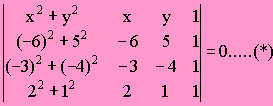
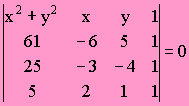
| The required circle is of the form: | Reasons: (1) The equation is of second degree and is a conic. (2) Coefficients of x^2 = y^2 and no xy- term, it is a circle. (3) Subst. P(-6, 5) in (*), we get R1 and R2 are equal and therefore P satisfies (*). Similarly for Q and R. Therefore the circle passes through P, Q, R. | |
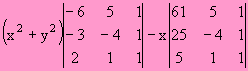
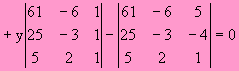
| Using Laplace expansion we get: Simplify, we get the equation of circle: | Although (*) is very simple and compact, its evaluation is complicate. You should know how to break down a higher order determinant. | |


Find the Center and Radius Then Write the Standard Equation of Each Circle Brainly
Source: https://qc.edu.hk/math/Advanced%20Level/circle%20given%203%20points.htm
0 Response to "Find the Center and Radius Then Write the Standard Equation of Each Circle Brainly"
Publicar un comentario